Start building today!
Experience the Find the courses and unlock the true potential
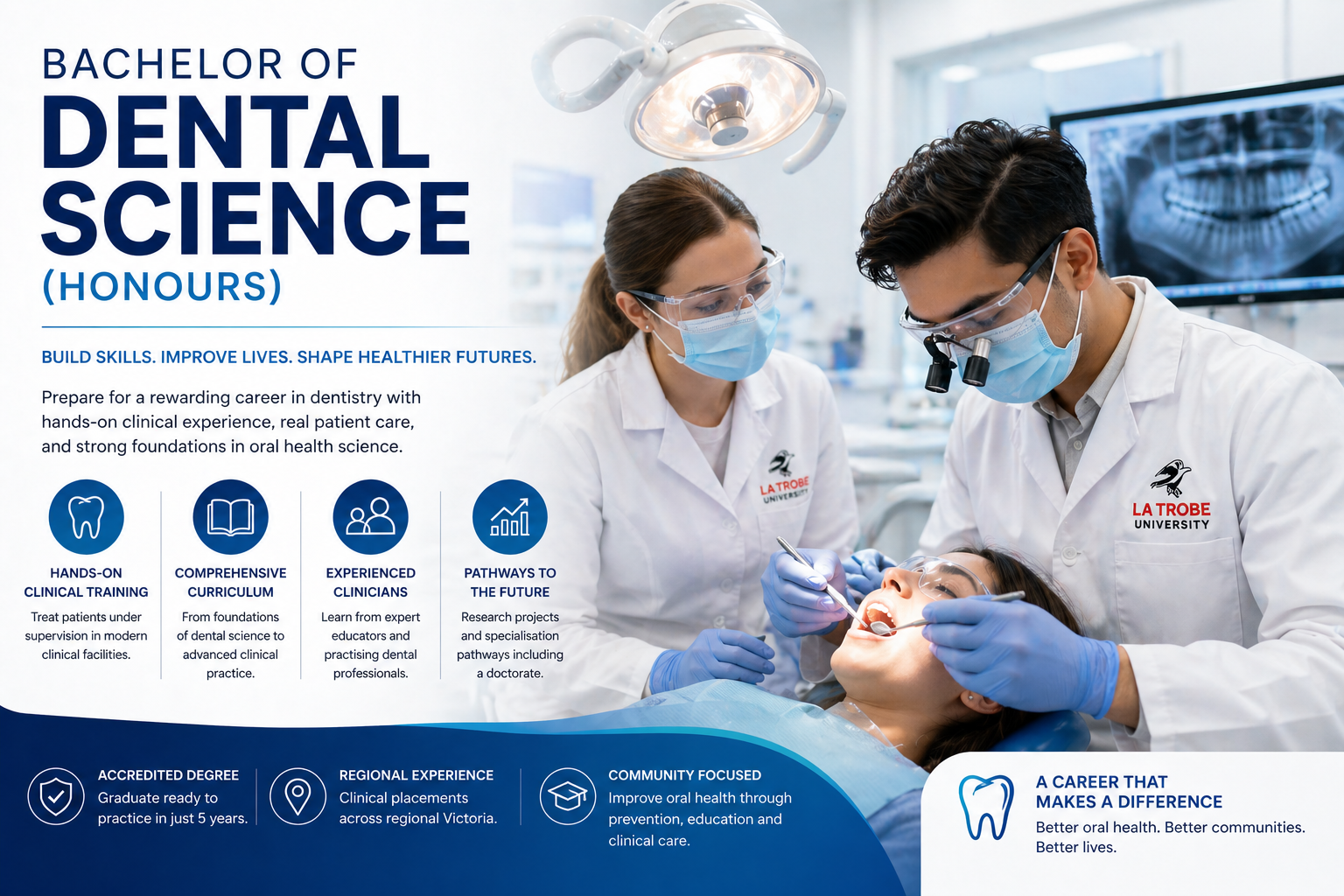
Dental Science and Dentistry degrees in Australia are among the most prestigious and competitive health qualifications available, producing graduates who are comprehensively trained to diagnose, prevent, and treat diseases and conditions affecting the oral cavity, teeth, gums, and surrounding structures. The course integrates a deep foundation in biological and medical sciences with the practical development of clinical skills, preparing students for the full scope of dental practice from routine examinations and restorations through to complex surgical interventions. Australia is home to some of the top dentistry schools in the world, operating within a dental industry valued at $13 billion, with over 21,200 employed dental professionals and annual employment growth of approximately 1,500 positions across the country.
Dentistry programs are designed for students with exceptional academic ability, strong manual dexterity, and a genuine commitment to patient-centred care. Programs are structured to develop the whole practitioner — scientific knowledge, clinical technique, communication skills, ethics, and professional identity are all woven through the curriculum. Graduates are equipped to work across a broad range of settings including private dental practices, public dental hospitals, community health centres, aged care facilities, government health departments, research institutions, and academic settings. All practising dentists in Australia must be registered with the Australian Health Practitioner Regulation Agency (AHPRA) through the Dental Board of Australia, and membership in the Australian Dental Association is available to all graduates of accredited programs. There are 13 approved dental specialties in Australia, giving graduates a rich array of pathways beyond general practice.
Australia faces a genuine and growing shortage of dental professionals, particularly in rural and regional areas, creating exceptional job security and strong demand for graduates entering the field. The dental workforce is strained by shortages and maldistribution, with general dentists in short supply nationwide — and as a result, recruitment incentives and remuneration are rising, with nearly half of practices boosting pay rates or offering flexible work arrangements to secure talent. Driven by an ageing population requiring more complex care, growing awareness of oral health, population growth, and a rising demand for cosmetic and orthodontic treatments, dentistry offers some of the most stable and financially rewarding career prospects in the entire healthcare sector.
Beyond job security, dentistry offers enormous personal satisfaction, clinical variety, and professional autonomy. Many dentists run their own private practices, giving them flexibility in scheduling and business ownership opportunities rarely found in other health professions. The field is also rapidly evolving — digital innovation is transforming dental practices, and continuous learning through specialisation, postgraduate study, and professional development is a defining feature of a long dental career. For students prepared to invest in a rigorous degree, the return — both financially and in terms of meaningful community impact — is exceptional.
Dentistry is among the most competitive courses to enter in Australia. For undergraduate entry, most programs require an ATAR between 95 and 99, with some of the most prestigious programs requiring an ATAR of 99 or above. Prerequisite subjects typically include Chemistry, Biology, and in some cases Advanced Mathematics at Year 12 level. Most universities also require applicants to sit the University Clinical Aptitude Test (UCAT ANZ), which assesses critical thinking, problem-solving, decision-making, and situational judgement — competitive applicants typically achieve scores in the 85th to 95th+ percentile range. Many universities also conduct formal interviews as the final stage of selection, with final ranking based on a weighted combination of ATAR, UCAT results, and interview performance.
For graduate-entry programs — such as the Doctor of Dental Medicine (DMD) or Doctor of Dental Surgery (DDS) — applicants must hold a relevant bachelor's degree (commonly in Biomedical Science, Health Science, or a related field) with a competitive GPA, and may be required to sit the Graduate Medical School Admissions Test (GAMSAT) in lieu of or in addition to UCAT. Some programs accept applicants with a high GPA of 5.0 or above on a 7-point scale. Alternative pathways exist for students from rural or remote backgrounds, First Nations students, and those who did not achieve a high ATAR, including transfer entry after one year of high-distinction performance in a related undergraduate degree.
For international applicants, English language proficiency is mandatory. To register with the Dental Board of Australia, applicants must demonstrate English language skills at IELTS Academic level 7.0 or equivalent. International students who did not complete their undergraduate studies in English may also be required to pass additional aptitude assessments such as the ISAT (International Student Admissions Test). All practising dentists, regardless of where they trained, must be registered with AHPRA, and overseas-trained dentists are required to complete the Australian Dental Council (ADC) examination process before obtaining registration.
This course may be offered in different study modes depending on the university, campus location, course structure and student type. Students should check the available delivery mode before applying, as not every study option is available at every institution.
On-campus study is the traditional mode of delivery where students attend classes, lectures, tutorials, workshops or seminars at the university campus. This option may suit students who prefer face-to-face learning, access to campus facilities, networking with classmates, practical workshops, group projects and direct engagement with academic staff.
Some universities may offer programs fully online or with online subject options. Online study can be attractive for students who need flexibility due to work, family, location or other commitments. Online study may suit domestic students, working professionals or students who want to study from outside Australia.
Hybrid or blended study usually combines online learning with some on-campus classes, workshops, intensive sessions or practical components. This mode may suit students who want flexibility but still want some face-to-face interaction. The exact structure varies between institutions.
Programs in Australia may have different intake structures depending on the university. The most common intake systems are semester, trimester and block mode.
Many Australian universities follow a two-semester academic calendar. The main intakes are commonly Semester 1 (around February or March) and Semester 2 (around July). Semester-based study usually allows students to complete a set number of subjects over approximately 12 to 14 weeks.
Some universities use a trimester system, which generally provides three study periods a year — around February/March, June/July and October/November. Trimester study may provide more flexibility and may help some students complete their course faster.
Some institutions may offer selected subjects or programs in block mode, where students focus on one subject at a time over a shorter, more intensive teaching period. Block mode may suit students who prefer concentrated learning or working professionals managing study around employment.
Some online or professionally focused programs may offer more frequent start dates or flexible entry points throughout the year. Students should not assume that every course has monthly or multiple intakes — availability depends on the institution, course structure and student type.
Graduates of Dental Science and Dentistry programs enjoy an exceptionally broad career landscape across Australia's public and private health sectors. Employment opportunities exist in private dental practices (which account for the vast majority of the industry), public dental hospitals, community health services, aged care facilities, Aboriginal and Torres Strait Islander health services, the Australian Defence Force, academia, research institutions, and government health agencies. Those who pursue postgraduate specialisation can access 13 approved dental specialties recognised in Australia, dramatically expanding both their scope of practice and earning potential. The sector continues to grow, with strong demand particularly in rural, regional, and remote areas where workforce shortages are most acute.
Entry Level
Graduate Dentist / Junior Associate
Graduate General Dentist, Dental House Officer, Junior Associate Dentist, Public Sector Dental Officer (Entry Grade)
Early Career
Associate Dentist / Dental Officer
Associate Dentist (Private Practice), Dental Officer (Community Health), Oral Health Therapist, General Practice Dentist
Mid-Level
Specialist Dentist / Senior Dentist
Orthodontist, Periodontist, Endodontist, Prosthodontist, Paediatric Dentist, Senior Dental Officer, Dental Educator
Senior Level
Principal Dentist / Senior Specialist
Principal Dentist, Oral and Maxillofacial Surgeon, Senior Specialist Consultant, Head of Dental Department, Academic Senior Lecturer
Leadership
Practice Owner / Director / Professor
Dental Practice Owner, Clinical Director, Director of Oral Health Services, Professor of Dentistry, Chief Dental Officer, Dental Group Medical Director
Dentistry is one of the highest-paying professions in Australia, with salaries varying significantly based on experience, specialisation, practice type (public vs. private), and geographic location.
Melbourne
Melbourne is home to one of Australia's most established dental education scenes, with a large concentration of public dental hospitals, specialist clinics, and private practices providing rich clinical placement opportunities. The city's diverse multicultural population and strong public health infrastructure make it an ideal environment for students to develop broad clinical experience across varied patient demographics.
Sydney
Sydney hosts Australia's largest and most advanced tertiary oral health facilities, offering students access to cutting-edge technology, high patient volumes, and a highly active private dental market. The city's large population and strong private health insurance uptake support a thriving dental industry, giving graduates excellent employment prospects across both the public and private sectors.
Brisbane
Brisbane offers dentistry students access to world-class oral health training centres, including one of Australia's most advanced tertiary oral health facilities, alongside a rapidly growing population driving strong demand for dental services. Queensland's mix of urban, regional, and remote communities also means students gain exposure to diverse patient needs and rural outreach placements.
Perth
Perth's dental sector is experiencing strong demand, with the city frequently cited as one of the highest-paying locations for dental practitioners in Australia. The Western Australian government actively supports rural dental workforce initiatives, and students based in Perth benefit from both a growing urban patient base and pathways to serve regional and remote communities across WA.
Adelaide
Adelaide provides an excellent environment for dental students, with strong clinical placement networks spanning city dental hospitals, regional South Australian clinics, and interstate sites from first year. The city's relatively affordable cost of living and close-knit health community mean students receive personalised mentoring and high-quality supervised clinical experience.
Canberra
Canberra offers dentistry students a unique setting within Australia's public sector and government health landscape, with access to ACT public health dental services and proximity to regional NSW communities in need of dental care. The city's highly educated workforce and government health funding priorities also create opportunities in public oral health policy, research, and academic roles.
Before choosing a course, students should compare:
International students who want to study in Australia should also consider additional requirements before applying.
Join successful graduates
Students Helped
Application Processed
Listed Universities
Listed Courses