Start building today!
Experience the Find the courses and unlock the true potential
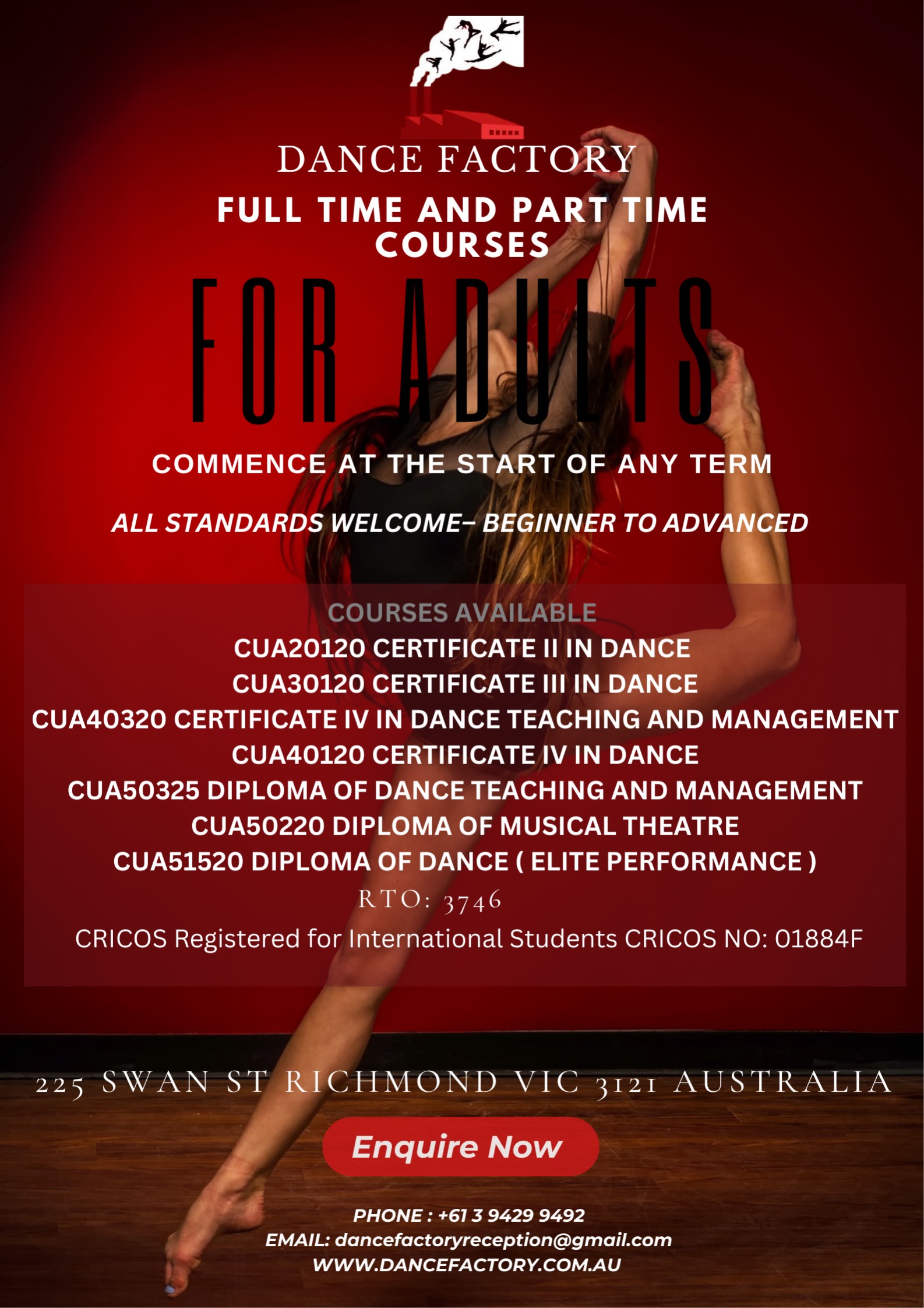
The Certificate IV in Dance (CUA40120) is a nationally recognised Australian Qualifications Framework (AQF) Level 4 vocational qualification delivered through Registered Training Organisations (RTOs) across Australia. The course reflects the role of individuals working in a wide variety of dance performance contexts, equipping students with advanced technical, creative, and conceptual skills to excel in their chosen styles. Typically completed over 12 to 24 months, the program covers multiple dance genres — including ballet, jazz, contemporary, tap, street dance, and cultural dance — while also developing professional knowledge in areas such as anatomy, safe dance practice, injury prevention, choreography, production management, and the business of the performing arts. Students complete a combination of core and elective units, totalling 13 units of competency, allowing them to tailor their learning towards performance, teaching, or choreography pathways.
The Certificate IV in Dance is designed for experienced dancers who have already demonstrated competency in at least one dance style at Certificate III level and are ready to take their skills into a professional or pre-professional context. It suits younger students completing their senior secondary education alongside vocational training, as well as those seeking a direct pathway into full-time performance training, a diploma-level qualification, or employment in the dance industry. The course is distinct from the Certificate IV in Dance Teaching and Management (CUA40320), which is oriented towards those pursuing careers in dance education and studio management rather than performance.
Employers and industry pathways for graduates span the full breadth of Australia's performing arts sector. These include professional dance companies, musical theatre productions, television and film productions, cruise ship entertainment, corporate events, dance studios, schools, community arts organisations, and the music and entertainment industries. Australia is home to world-renowned organisations such as The Australian Ballet, Sydney Dance Company, Bangarra Dance Theatre, and numerous independent contemporary dance companies, all of which represent aspirational employers for graduates of this qualification.
Australia's dance industry is vibrant and diverse, offering opportunities across ballet, contemporary, commercial, and cultural dance styles for trained performers, teachers, and choreographers. The demand for skilled, professionally qualified dance practitioners continues to grow, with the total number of dancers and choreographers trending upward in Australia since the early 1990s. A nationally recognised qualification like the Certificate IV in Dance signals to employers, casting directors, and dance companies that a graduate has met rigorous industry standards and is prepared for the demands of professional performance or instruction. In an industry where auditions, residencies, and networking are central to career entry, holding a formal credential provides a genuine competitive advantage.
Beyond performance, the qualification opens doors to a wide range of sustainable career pathways, including teaching, choreography, arts administration, dance therapy, and community arts facilitation — all areas experiencing growing community and institutional demand across Australia. Many dance artists build portfolio careers combining performance, teaching, and creative work, and the skills developed through this qualification — from anatomy and self-care to choreography and production design — directly underpin this multi-hyphenate career model. With Australia's live performance and creative industries continuing to recover and grow post-pandemic, there is a genuine need for formally trained dance artists who can contribute to the richness and diversity of the sector.
To enrol in the Certificate IV in Dance, applicants are generally required to demonstrate prior dance competency equivalent to Certificate III level in at least one dance style. This is typically evidenced through a formal audition conducted in person or via video submission, where the applicant demonstrates technical ability and performance quality in their chosen genre. Some providers also accept formal examination certifications from recognised dance examination bodies such as the Royal Academy of Dance (RAD), CSTD, BATD, or equivalent, particularly for the Dance Teaching and Management pathway. There are generally no formal academic prerequisites, meaning students do not need to have completed Year 12, though many students undertake this qualification concurrently with their senior secondary education to earn ATAR credits (available in some states such as South Australia through the SACE).
Most providers set a minimum age requirement, typically 15 years of age, reflecting the vocational and sometimes studio-based nature of the training. International students must meet English language requirements, which vary by provider but are generally in line with IELTS 5.5 or equivalent. Students may also need to provide a Working With Children Check (or state equivalent) prior to undertaking any supervised teaching or practical placement components, particularly in providers offering the Dance Teaching and Management specialisation. Some providers may require a short written statement of intent or evidence of commitment to a dance career as part of the application process.
This course may be offered in different study modes depending on the university, campus location, course structure and student type. Students should check the available delivery mode before applying, as not every study option is available at every institution.
On-campus study is the traditional mode of delivery where students attend classes, lectures, tutorials, workshops or seminars at the university campus. This option may suit students who prefer face-to-face learning, access to campus facilities, networking with classmates, practical workshops, group projects and direct engagement with academic staff.
Some universities may offer programs fully online or with online subject options. Online study can be attractive for students who need flexibility due to work, family, location or other commitments. Online study may suit domestic students, working professionals or students who want to study from outside Australia.
Hybrid or blended study usually combines online learning with some on-campus classes, workshops, intensive sessions or practical components. This mode may suit students who want flexibility but still want some face-to-face interaction. The exact structure varies between institutions.
Programs in Australia may have different intake structures depending on the university. The most common intake systems are semester, trimester and block mode.
Many Australian universities follow a two-semester academic calendar. The main intakes are commonly Semester 1 (around February or March) and Semester 2 (around July). Semester-based study usually allows students to complete a set number of subjects over approximately 12 to 14 weeks.
Some universities use a trimester system, which generally provides three study periods a year — around February/March, June/July and October/November. Trimester study may provide more flexibility and may help some students complete their course faster.
Some institutions may offer selected subjects or programs in block mode, where students focus on one subject at a time over a shorter, more intensive teaching period. Block mode may suit students who prefer concentrated learning or working professionals managing study around employment.
Some online or professionally focused programs may offer more frequent start dates or flexible entry points throughout the year. Students should not assume that every course has monthly or multiple intakes — availability depends on the institution, course structure and student type.
Graduates of the Certificate IV in Dance enter a dynamic and diverse Australian performing arts landscape, where career paths extend well beyond the stage. While many graduates pursue performance careers with professional dance companies, musical theatre productions, film, television, and commercial entertainment — including cruise ships, theme parks, and music video production — others build rewarding careers in dance education, choreography, community arts, arts administration, and movement-based therapies. The portfolio career model is especially common in Australia's dance sector, with many practitioners combining performance, teaching, choreography, and creative project work across their professional lives.
Entry Level
Emerging Performer / Junior Dance Artist
Ensemble Dancer, Junior Company Dancer, Dance Fitness Instructor, Junior Dance Teacher, Cruise Ship Performer
Early Career
Professional Dancer / Dance Instructor
Professional Stage Dancer, Commercial Dancer, Dance Studio Instructor, Freelance Choreographer, Community Dance Facilitator
Mid-Level
Senior Dancer / Choreographer
Lead Performer, Assistant Choreographer, Senior Dance Teacher, Dance Company Member, Movement Coach, Performing Arts Educator
Senior Level
Principal Dancer / Head Choreographer
Principal Dancer, Head Choreographer, Dance Studio Manager, Arts Programme Coordinator, Resident Choreographer, Senior Dance Educator
Leadership
Artistic Director / Studio Owner / Company Director
Artistic Director, Dance Company Director, Dance Studio Owner, Performing Arts School Principal, Creative Producer, Dance Department Head
Salaries in the Australian dance industry vary considerably based on employment type (employed vs. freelance), experience level, dance style, and employer sector, with many practitioners earning income from multiple sources simultaneously.
Melbourne
Melbourne is Australia's contemporary dance capital, home to world-class companies including Chunky Move, Lucy Guerin Inc, Dancehouse, and the Australian Ballet, offering unparalleled access to professional mentors, residencies, and performance opportunities. The city's thriving arts festival scene — including the Melbourne International Arts Festival and Melbourne Fringe — and its concentration of dance studios, training providers, and independent companies make it the ideal city for aspiring dancers seeking immersion in the industry.
Sydney
Sydney hosts some of Australia's most prestigious performing arts institutions and major commercial dance employers, including the Sydney Dance Company, Opera House productions, and a thriving musical theatre sector that regularly produces large-scale shows. The city's active commercial entertainment scene — spanning music videos, television, advertising, and corporate events — provides Certificate IV graduates with diverse professional opportunities across both artistically driven and commercial performance contexts.
Brisbane
Brisbane's growing arts and entertainment sector, supported by Queensland Performing Arts Centre (QPAC), Queensland Ballet, and a strong eisteddfod and competition culture, makes it a dynamic location for dance training and early career development. The city's expanding live events industry and proximity to the Gold Coast — a hub for theme park entertainment and cruise ship recruitment — adds further commercial performance pathways for graduates.
Perth
Perth is home to a vibrant and close-knit dance community, with West Australian Ballet, STRUT Dance, and the Western Australian Academy of Performing Arts (WAAPA) providing a rich ecosystem of professional development, performance, and networking opportunities. The city's strong arts funding environment and growing festival sector offer Certificate IV graduates meaningful pathways into both performance and community arts roles in a less saturated market than the east coast.
Adelaide
Adelaide punches well above its weight in the performing arts, hosting the Adelaide Fringe — the world's second-largest arts festival — and a dynamic independent performance scene that regularly attracts national and international work. Studying dance in Adelaide offers access to a highly supportive arts community, affordable training costs, and real opportunities to perform and connect with industry professionals through the city's year-round festival calendar.
Canberra
Canberra's dance community is small but well-supported, with organisations such as Kulture Break and QL2 Dance providing strong pathways for emerging artists, particularly in youth dance and community arts facilitation. Students in Canberra benefit from government arts funding and a stable employment environment that values community engagement, making it an especially good base for graduates interested in arts education, community dance programmes, and working with culturally diverse populations.
Before choosing a course, students should compare:
International students who want to study in Australia should also consider additional requirements before applying.
Join successful graduates
Students Helped
Application Processed
Listed Universities
Listed Courses