

Start building today!
Experience the Find the courses and unlock the true potential
Course Overview
Where You Can Study
Perth
35 Stirling Hwy, CRAWLEY, WA 6009
Eligibility
International equivalencies:
Career & Study Pathways
Quality & Recognition
Academic Regulator
TEQSA
Professional Body
Surveying and Spatial Sciences Institute (SSSI) / State Surveyors Board
Accreditation Status
AccreditedSkills Assessor
VETASSESS / State Surveyors Board
Course Content
Science Work Placement Unit
Work Integrated Learning unit providing hands-on, practical industry relevant experience.
Science Consultancy Project
Work Integrated Learning unit providing real-time, hands-on and practical industry relevant experience.
WA Parliamentary Research Program
Work Integrated Learning option through the WA Parliamentary Research Program.
McCusker Centre for Citizenship Internship
Work Integrated Learning internship option through the McCusker Centre for Citizenship.
McCusker Centre for Citizenship Internship
Work Integrated Learning internship option through the McCusker Centre for Citizenship.
Geographies of Economic Development
Work Integrated Learning option in geographies of economic development.
Geographies of Economic Development
Work Integrated Learning option in geographies of economic development.
Common Questions
Yes. After completing the first three years of study (the Geographical and Spatial Science extended major), you can choose to exit with a Bachelor of Geographical and Spatial Science (Advanced), or you can continue into the final year to complete the Master of Environmental Science.
The master's component focuses on understanding the impact of human activity on the environment, developing scientific, risk-based solutions to global challenges. Topics include climate change, water resource management, sustainable natural resource use, and the rehabilitation of degraded and polluted environments, with an interdisciplinary approach drawing on environmental processes and human-environment interactions.
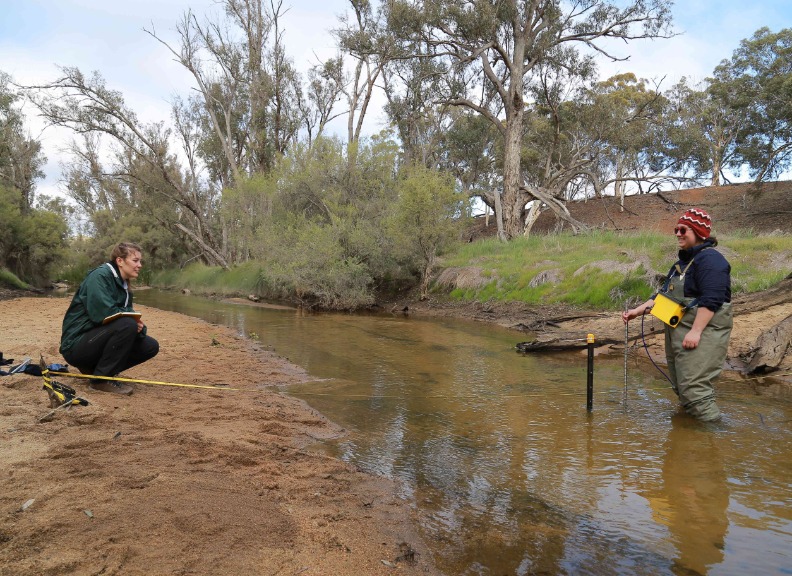
You will gain hands-on experience through GIS and remote sensing technologies, field-based data collection, and laboratory-based analysis. The course also includes Work Integrated Learning (WIL) options such as science work placements, science consultancy projects, parliamentary research programs, and internships through the McCusker Centre for Citizenship. UWA also has a Remotely Piloted Aerial Sensing Platform providing access to drones and sensing equipment.
The Master of Environmental Science offers specialisations in Environmental Management, Marine and Coastal, Catchments and Water, Environmental Rehabilitation, Sensing and Environmental Data, and Environmental Economics.
UWA is ranked 1st in Western Australia and 3rd in Australia for Environmental Science and Engineering (GRAS 2025), and 44th in the world for Environmental Sciences and Engineering (GRAS 2024). Graduates with GIS and spatial science skills are in high demand and command a premium salary in the job market, with opportunities across industries such as environmental consulting, mining, agriculture, health, and international development.
Application
Three simple steps to get enrolled
Step 01
Enquire
Click "Enquire Now" and tell us a little about yourself. It's free and takes 2 minutes.
Step 02
Submit Documents
Our team will guide you on exactly which documents to prepare and submit.
Step 03
Get Enrolled
Receive your offer letter and confirm your enrolment. Welcome to the course!
Honestly I was lost when I first started looking at Australian colleges. There are just too many options and every agent gives you different info. A friend told me about FindTheCourses and within a week I had shortlisted 3 programs that actually matched my budget and visa situation. My advisor Sanjay was super helpful — never felt like I was being pushed into anything.

Priya Sharma
India
Master of Nursing · Griffith University

