

Start building today!
Experience the Find the courses and unlock the true potential
Course Overview
Where You Can Study
Brisbane
66 Ernest St, South Brisbane, QLD 4101
Student Information
Provider's Published Fee
Duration
Eligibility
Domestic Students:
International Students:
Career & Study Pathways
Quality & Recognition
Academic Regulator
TEQSA
Professional Body
Australian Nursing and Midwifery Accreditation Council (ANMAC)
Accreditation Status
AccreditedSkills Assessor
ANMAC
Course Content
Communication for Health Professionals
This Unit introduces you to the theory and practice of communication, with direct application to professional practice in Nursing. You will learn about all forms of effective communication, including evidence-based and collaborative practice, culturally safe and respectful communication, and professional integrity.
Introduction to Nursing Practice
This Unit establishes fundamental knowledge and skills to provide basic nursing care, with consideration to professional standards, and legal and ethical frameworks.
Lifespan Development
This Unit aims to develop foundational knowledge of psychosocial concepts that underpin human behaviour across their lifespan, including health assessments and the care of individuals, families and communities.
Anatomy & Physiology 1
This Unit introduces you to the foundational knowledge of the normal structure and function of the human body, including an understanding of the integrative nature of physiological systems. You will review the mechanisms that regulate and control the activity of human physiological systems across the lifespan.
Simulated Laboratory
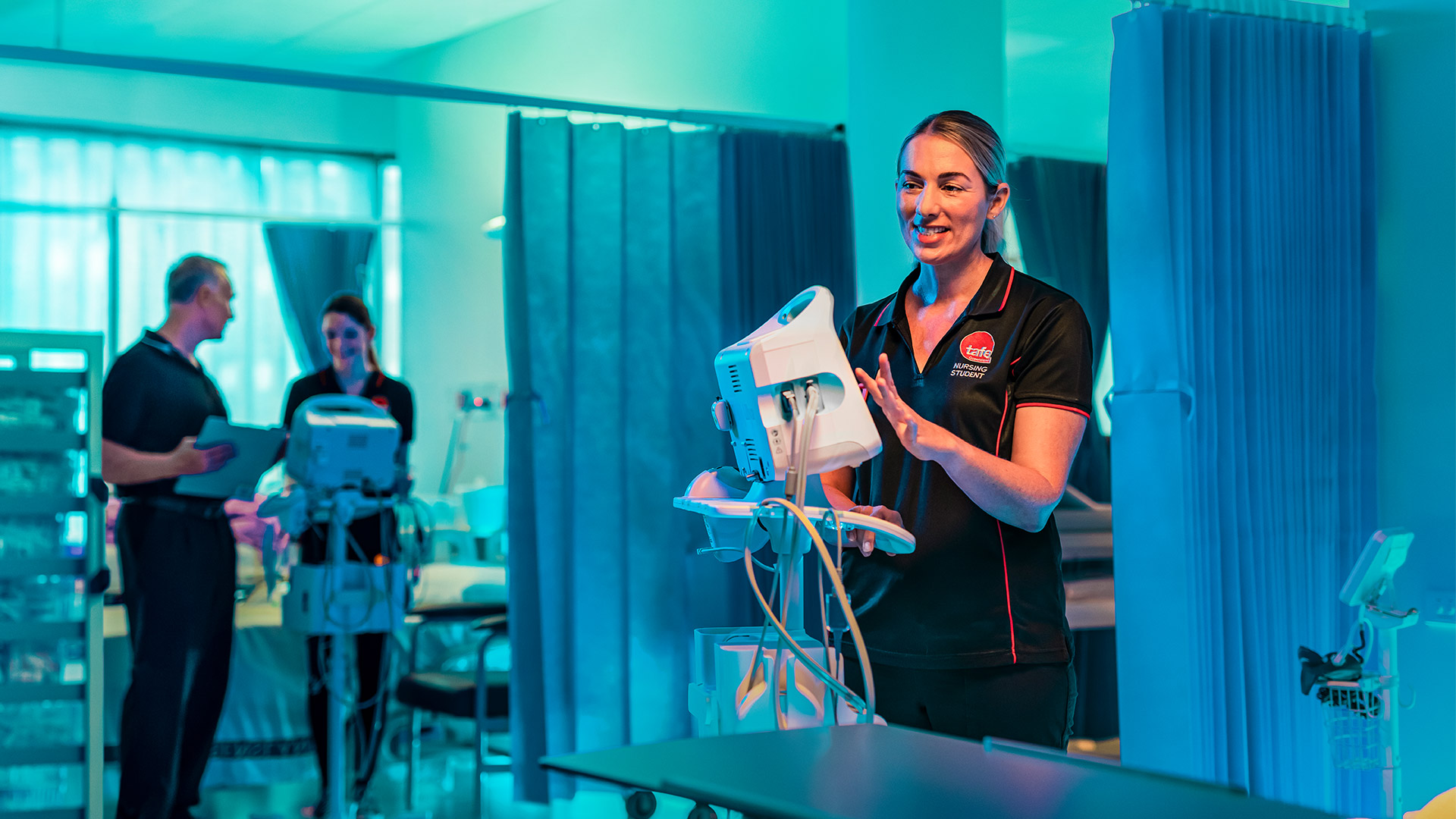
The purpose of mandatory simulated laboratory sessions is to create a supportive learning environment, allowing you to practice and refine your nursing skills in a safe and controlled setting.
Applied Anatomy & Physiology
This Unit develops your understanding of the interconnectedness in multisystem physiology, including cardiovascular system anatomy, and body systems including renal, respiratory, digestive, lymphatics and reproductive systems.
Health Assessment
This Unit develops your knowledge and clinical skills to facilitate the performance of a comprehensive health assessment, with a focus on safe and effective clinical decision-making.
First Nations Australians Health and Wellness
This Unit develops knowledge, skills and awareness of Aboriginal and Torres Strait Islander Peoples' culture and health for culturally safe delivery of nursing care.
Professional Nursing Practice
The focus of this Unit is to practice fundamental nursing care in the aged care environment, including understanding of co-morbidities and different cognitive impacts of ageing.
Simulated Laboratory
The purpose of mandatory simulated laboratory sessions is to create a supportive learning environment, allowing you to practice and refine your nursing skills in a safe and controlled setting.
Professional Experience Placement
Professional Experience Placement [PEP] are a mandatory component of this course. PEP is embedded throughout the course to provide quality learning experiences, in a variety of health care settings, that develop your knowledge and skills, to prepare you to practice as a registered nurse.
Acute Nursing (Medical/Surgical)
In this Unit you develop knowledge of caring for individuals who may have a range of medical/surgical needs.
Pathophysiology and Pharmacology 1
This Unit provides you with knowledge of altered physiological states, homeostatic maintenance, pathological, pharmacological, and microbiological processes of the body.
Health Law and Ethics for Health Professionals
In this Unit you will examine the Australian legal system and relevant statutory bodies in order to understand legislation affecting health policy and nursing practice. You will gain an understanding of ethical decision-making frameworks relevant to nursing, and apply theoretical knowledge to critically analyse contemporary legal and ethical issues in health care practice.
Mental Health Nursing
This Unit provides a theoretical and practical knowledge of mental health issues, and appropriate treatment responses.
Simulated Laboratory
The purpose of mandatory simulated laboratory sessions is to create a supportive learning environment, allowing you to practice and refine your nursing skills in a safe and controlled setting.
Professional Experience Placement
Professional Experience Placement [PEP] are a mandatory component of this course. PEP is embedded throughout the course to provide quality learning experiences, in a variety of health care settings, that develop your knowledge and skills, to prepare you to practice as a registered nurse.
Applied Pathophysiology and Pharmacology
This Unit develops knowledge of the pathophysiology and pharmacological treatment modalities for the musculoskeletal, hematological, gastrointestinal, integumentary and reproductive systems.
Primary and Public Health
The aim of this Unit is to explore foundational principles of Primary and Public Health nursing across varied settings, including social determinants of health and illness.
Primary Nursing Care of the Older Adult
This Unit provides theoretical and practical application of primary nursing care for working with older adults across varied settings.
Chronic Disease Management
This Unit provides knowledge to assess, plan and deliver safe and quality care to individuals with a chronic condition, including individuals, family, and community across a variety of contexts.
Simulated Laboratory
The purpose of mandatory simulated laboratory sessions is to create a supportive learning environment, allowing you to practice and refine your nursing skills in a safe and controlled setting.
Professional Experience Placement
Professional Experience Placement [PEP] are a mandatory component of this course. PEP is embedded throughout the course to provide quality learning experiences, in a variety of health care settings, that develop your knowledge and skills, to prepare you to practice as a registered nurse.
Complex Nursing Care
In this Unit you will examine complex health problems drawing on the National Health priority areas. You will examine pathophysiological processes and consider nursing assessment, care planning and management which help to restore and support optimal health.
Research for Health Professionals
This Unit provides knowledge and application of research in clinical practice, using evidence-based practice.
Informatics, Digital and Telehealth
This Unit provides knowledge of digital health and electronic systems to communicate and store health care data, to promote person-centered care.
Community Health
This Unit provides foundational principles of community nursing including health promotion, primary health care, epidemiology and consideration of social determinants of health.
Simulated Laboratory
The purpose of mandatory simulated laboratory sessions is to create a supportive learning environment, allowing you to practice and refine your nursing skills in a safe and controlled setting.
Professional Experience Placement
Professional Experience Placement [PEP] are a mandatory component of this course. PEP is embedded throughout the course to provide quality learning experiences, in a variety of health care settings, that develop your knowledge and skills, to prepare you to practice as a registered nurse.
Professional Leadership & Management
This Unit prepares you for your professional role as a Registered Nurse (RN), you will develop clinical leadership knowledge and skills and consider their application to your future practice. You will critically appraise your leadership qualities and practices and develop capabilities in clinical supervision and delegation.
Transition to Professional Practice
This Unit provides the knowledge and skills to identify risk, and respond appropriately to workplace environmental challenges and expectations, highlight awareness of the global nature of nursing.
Advanced Clinical Decision Making
This Unit provides practical experience in the application of the decision-making framework, and the NMBA Registered nurse standards for practice.
Simulated Laboratory
The purpose of mandatory simulated laboratory sessions is to create a supportive learning environment, allowing you to practice and refine your nursing skills in a safe and controlled setting.
Professional Experience Placement
Professional Experience Placement [PEP] are a mandatory component of this course. PEP is embedded throughout the course to provide quality learning experiences, in a variety of health care settings, that develop your knowledge and skills, to prepare you to practice as a registered nurse.
Pathology Techniques - 35 hours placement
Advanced Wound Care
The aim of this Unit is to develop advanced understanding of acute and chronic wound management, with a focus on the anatomy and physiology of the skin, the physiology of wound healing, factors affecting wound healing, holistic wound assessment, principles of wound management and explores specific types of wounds and their management.
Common Questions
Yes, TAFE Queensland's Bachelor of Nursing is specifically designed as an EN to RN pathway for Diploma of Nursing (HLT54121) graduates. Eligible diploma graduates could transition seamlessly into the nursing degree with a full year of credit, subject to eligibility checks during enrolment.
The Bachelor of Nursing is delivered flexibly, allowing you to learn online and face to face at the South Bank campus in Brisbane and the Southport campus on the Gold Coast.
Yes, the degree is approved by the Nursing and Midwifery Board of Australia (NMBA) and provides the necessary academic qualification for eligibility as a Registered Nurse in Australia. It is also listed as an approved course with the Australian Health Practitioner Regulation Agency (AHPRA) and recognised by TEQSA, the Australian Nursing & Midwifery Accreditation Council (ANMAC), and the NMBA.
Yes, one of the key advantages of the EN to RN pathway is that completing the Diploma of Nursing first gives you the knowledge and skills to start working in the industry and earning money while you finish your degree.
The Bachelor of Nursing is available on a part-time basis and can take up to 6 years to complete. The next intake starts on 25 Jan 2027 (South Bank) / 27 Jan 2027 (Southport).
Application
Three simple steps to get enrolled
Step 01
Enquire
Click "Enquire Now" and tell us a little about yourself. It's free and takes 2 minutes.
Step 02
Submit Documents
Our team will guide you on exactly which documents to prepare and submit.
Step 03
Get Enrolled
Receive your offer letter and confirm your enrolment. Welcome to the course!
Processing time: Offer letter issued within approximately 1 business days.
Honestly I was lost when I first started looking at Australian colleges. There are just too many options and every agent gives you different info. A friend told me about FindTheCourses and within a week I had shortlisted 3 programs that actually matched my budget and visa situation. My advisor Sanjay was super helpful — never felt like I was being pushed into anything.

Priya Sharma
India
Master of Nursing · Griffith University

