

Start building today!
Experience the Find the courses and unlock the true potential
Course Overview
Where You Can Study
GoldCoast
101 A, 9 Bay St, Southport,, Queensland 4215
Eligibility
International Students:
Be at least 18 years of age
Participate in a course entry interview (pre-enrolment review) to determine suitability of the course and additional support needs
Undertake HTA's ACSF Level 5 LLND assessment
Must have access to and bring their own portable device (laptop or iPad and other tablets with a keyboard) to class with up-to-date Microsoft Office suite (Word, PowerPoint, Outlook, Excel)
Must provide evidence of English Language proficiency as stated under the English Language Requirements below
English Language Requirements (minimum scores, no ELICOS):
IELTS: 6.0
TOEFL internet-based test: 64
Cambridge English: Advanced (CAE): 169
Pearson Test of English Academic (PTE Academic): 50
Occupational English Test: B for each test component
Domestic Students:
Be at least 18 years of age
Participate in a course entry interview (pre-enrolment review) to determine suitability of the course and additional support needs
Undertake HTA's ACSF Level 5 LLN assessment
Must have access to and bring their own portable device (laptop or iPad and other tablets with a keyboard) to class with up-to-date Microsoft Office suite (Word, PowerPoint, Outlook, Excel)
Career & Study Pathways
This qualification offers a pathway to employment in diverse settings where patisserie items are prepared and served, including:
Patisseries
Restaurants
Hotels
Catering services
Clubs
Pubs
Cafés
Coffee shops
Job roles include:
Bakery Assistant
Pastry Chef
Pâtissier
Quality & Recognition
Academic Regulator
ASQA
Professional Body
Tourism, Hospitality and Events Industry Body
Accreditation Status
AccreditedSkills Assessor
TRA (Trades Recognition Australia)
Course Content
Use hygienic practices for food safety
Core unit
Participate in safe food handling practices
Core unit
Use food preparation equipment
Core unit
Prepare dishes using basic methods of cookery
Core unit
Receive, store and maintain stock
Core unit
Participate in safe work practices
Core unit
Coach others in job skills
Core unit
Produce desserts
Core unit
Clean kitchen premises and equipment
Core unit
Work effectively in a commercial kitchen
Core unit
Produce cakes
Core unit
Produce specialised cakes
Core unit
Produce pastries
Core unit
Produce yeast-based bakery products
Core unit
Produce petits fours
Core unit
Prepare food to meet special dietary requirements
Elective – Group A
Plan and cost recipes
Elective – Group A
Provide First Aid
Elective – Group C
Purchase goods
Elective – Group C
Prepare and serve espresso coffee
Elective – Group B
Prepare Asian desserts
Elective – Group A
Common Questions
The qualification is delivered over 52 weeks, including 40 weeks of training and assessment and 12 weeks of holidays. Students attend face-to-face training 20 hours per week in a classroom.
The sample weekly timetable is: Wednesday 8am–12.15pm (including a 15-minute break), Thursday 8am–5pm (including a 1-hour break), and Friday 8am–5pm (including a 1-hour break). Supplementary classes may also be scheduled as needed.
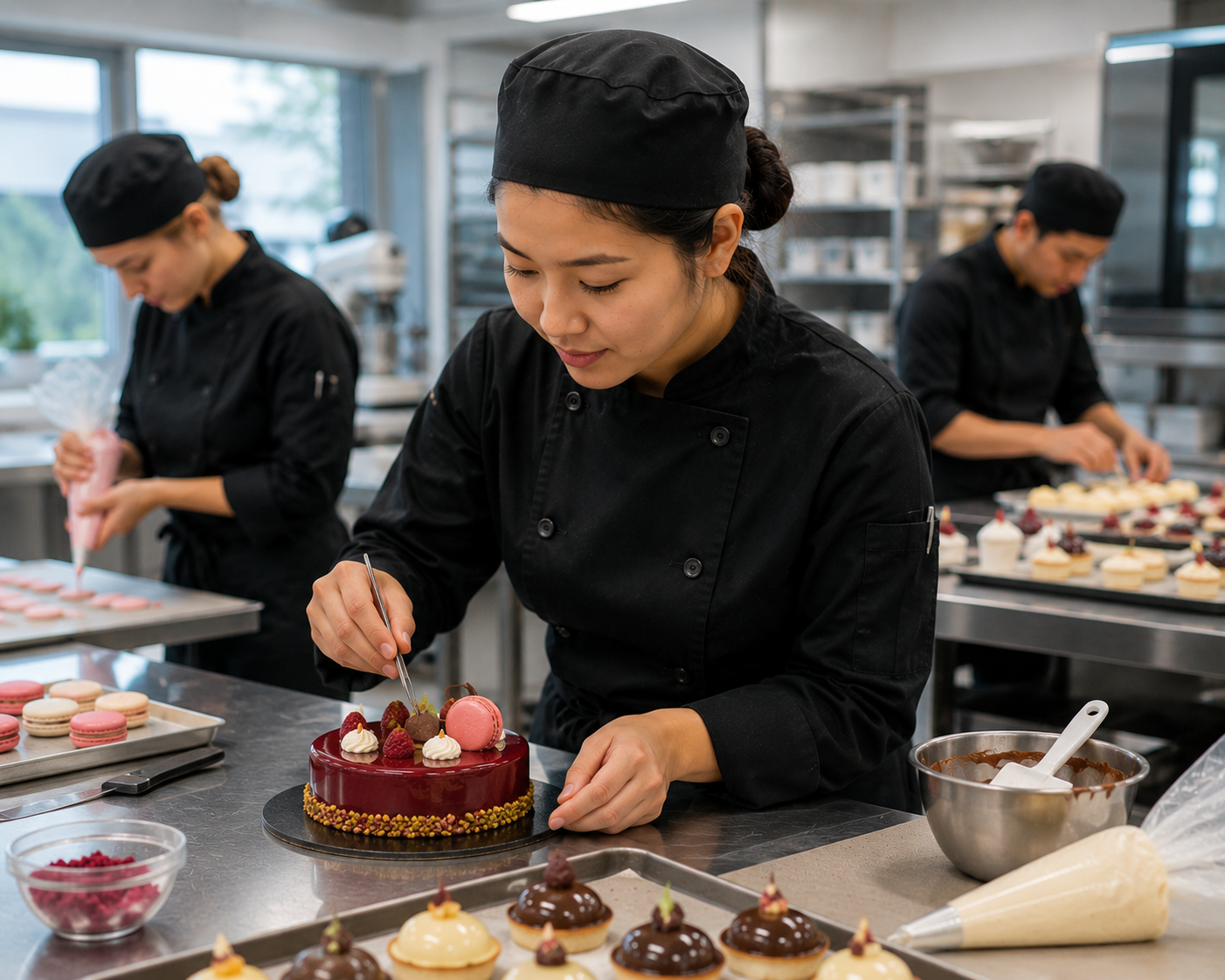
All Hospitality students will be given one full set of chef's uniform (charges included in fees) through the designated supplier. The uniform consists of a chef's jacket, trousers, apron, chef's hat, protective footwear, and a full set of knives for all practical classes (to be always locked). Students must wear the full set of chef's uniform when attending training in the commercial kitchen.
Upon completion of the Certificate III in Patisserie, students may enrol in the Certificate IV in Patisserie or the Diploma of Hospitality Management to further enhance their knowledge and skills.
Assessment is based on the principles of competency-based training and uses a variety of assessment strategies. Classroom-based assessment includes classroom exercises, assignments, practical demonstrations, group activities, projects, and verbal and/or written questions. Assessment for each unit of competence will be through a combination of classroom-based and work placement tasks. Students are advised well in advance of assessment activities and assessment criteria are documented in all modules and workbooks.
Application
Three simple steps to get enrolled
Step 01
Enquire
Click "Enquire Now" and tell us a little about yourself. It's free and takes 2 minutes.
Step 02
Submit Documents
Our team will guide you on exactly which documents to prepare and submit.
Step 03
Get Enrolled
Receive your offer letter and confirm your enrolment. Welcome to the course!
Processing time: Offer letter issued within approximately 1 business days.
Honestly I was lost when I first started looking at Australian colleges. There are just too many options and every agent gives you different info. A friend told me about FindTheCourses and within a week I had shortlisted 3 programs that actually matched my budget and visa situation. My advisor Sanjay was super helpful — never felt like I was being pushed into anything.

Priya Sharma
India
Master of Nursing · Griffith University

