Start building today!
Experience the Find the courses and unlock the true potential
60 weeks
Face-to-face classroom delivery,
20 hours per week
Course Overview
Where You Can Study
Brisbane
9 Bay St, SOUTHPORT, QLD 4215
Eligibility
International Students:
Be at least 18 years of age
Participate in a course entry interview (pre-enrolment review) to determine suitability of the course and additional support needs
Undertake HTA's ACSF Level 5 LLND assessment
Must have access to and bring their own portable device (laptop or iPad and other tablets with a keyboard) to class with up-to-date Microsoft Office suite (Word, PowerPoint, Outlook, Excel)
Must provide evidence of English Language proficiency as stated under the English Language Requirements below
English Language Requirements (minimum scores, no ELICOS):
IELTS: 6.0
TOEFL internet-based test: 64
Cambridge English: Advanced (CAE): 169
Pearson Test of English Academic (PTE Academic): 50
Occupational English Test: B for each test component
Domestic Students:
Be at least 18 years of age
Participate in a course entry interview (pre-enrolment review) to determine suitability of the course and additional support needs
Undertake HTA's ACSF Level 5 LLN assessment
Must have access to and bring their own portable device (laptop or iPad and other tablets with a keyboard) to class with up-to-date Microsoft Office suite (Word, PowerPoint, Outlook, Excel)
Career & Study Pathways
Completing this qualification contributes to recognition as a trade cook
Provides a pathway to employment in various settings, including restaurants, hotels, clubs, pubs, cafes, and coffee shops
Prepares a person to select, adapt, and transfer skills to a new environment
Enables the person to provide technical advice and some leadership in resolving specific problems
Study Pathway: Diploma of Hospitality Management
Quality & Recognition
Academic Regulator
ASQA
Professional Body
Tourism, Hospitality and Events Industry Body
Accreditation Status
AccreditedSkills Assessor
TRA (Trades Recognition Australia)
Course Content
Use hygienic practices for food safety
Core unit
Participate in safe food handling practices
Core unit
Use food preparation equipment
Core unit
Prepare dishes using basic methods of cookery
Core unit
Participate in safe work practices
Core unit
Prepare appetisers and salads
Core unit
Prepare stocks, sauces and soups
Core unit
Prepare vegetable, fruit, eggs and farinaceous dishes
Core unit
Prepare vegetarian and vegan dishes
Core unit
Prepare poultry dishes
Core unit
Prepare meat dishes
Core unit
Prepare seafood dishes
Core unit
Produce cakes, pastries and breads
Core unit
Prepare food to meet special dietary requirements
Core unit
Clean kitchen premises and equipment
Core unit
Plan and cost recipes
Core unit
Produce desserts
Core unit
Coach others in job skills
Core unit
Receive, store and maintain stock
Core unit
Work effectively as a cook
Core unit
Package prepared foodstuffs
Elective – Group A
Produce cook-chill and cook-freeze foods
Elective – Group A
Re-thermalise chilled and frozen foods
Elective – Group A
Provide First Aid
Elective – Group C
Purchase goods
Elective – Group C
Common Questions
The qualification is delivered over 60 weeks, including 48 weeks of training and assessment and 12 weeks of holidays. Students are required to attend face-to-face training 20 hours per week in a classroom.
The sample weekly timetable is: Monday 8am–5pm (including 1-hour break), Tuesday 8am–5pm (including 1-hour break), and Wednesday 8am–12:15pm (including 15-minute break). Supplementary classes may be scheduled if additional sessions are needed to make up for public holidays, missed sessions, or for students requiring further training or support.
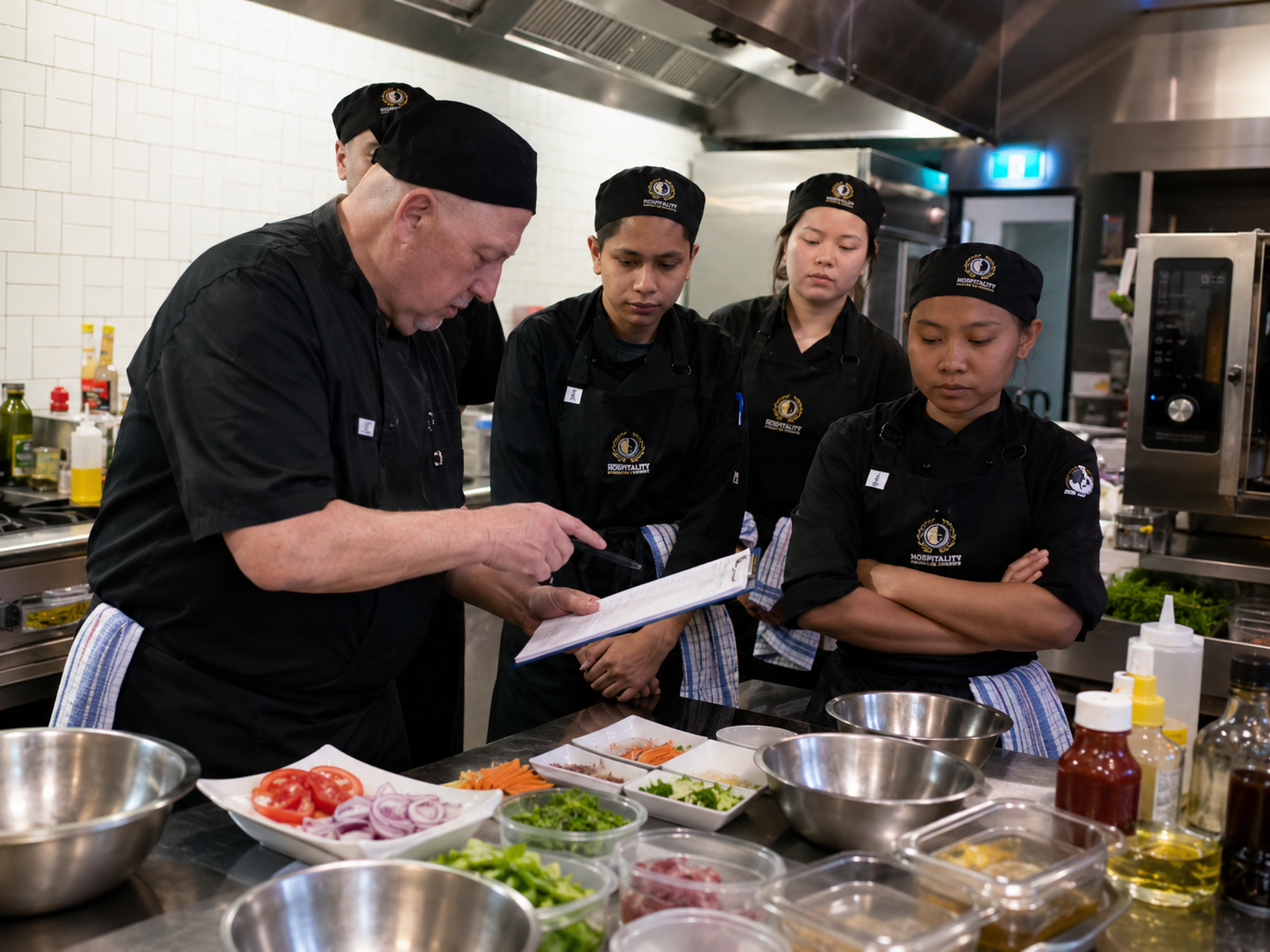
All Hospitality students will be given one full set of chef's uniform (charges included in fees) through a designated supplier, consisting of a chef's jacket, trousers, apron, chef's hat, protective footwear, and a full set of knives for all practical classes (to be locked at all times). Students must wear the full chef's uniform when attending training in the commercial kitchen. For theory classes, students must wear an HTA shirt or blouse, any colour trousers or skirt, and flat black non-slip covered shoes.
International students must provide evidence of English proficiency, with minimum scores of IELTS 6.0, TOEFL iBT 64, Cambridge English Advanced (CAE) 169, PTE Academic 50, or OET Band B for each component. Lower scores may be accepted with additional ELICOS study (10 or 20 weeks). Students are exempt from providing English test evidence if they hold a passport from the UK, USA, Canada, New Zealand, or Republic of Ireland, among other specified exemption categories.
Upon completion of the Certificate IV in Kitchen Management, students may enrol in the Diploma of Hospitality Management to further enhance their knowledge and skills. Additionally, if all units of competency are not achieved, a Statement of Attainment will be issued for the units that have been deemed competent.
Application
Three simple steps to get enrolled
Step 01
Enquire
Click "Enquire Now" and tell us a little about yourself. It's free and takes 2 minutes.
Step 02
Submit Documents
Our team will guide you on exactly which documents to prepare and submit.
Step 03
Get Enrolled
Receive your offer letter and confirm your enrolment. Welcome to the course!
Honestly I was lost when I first started looking at Australian colleges. There are just too many options and every agent gives you different info. A friend told me about FindTheCourses and within a week I had shortlisted 3 programs that actually matched my budget and visa situation. My advisor Sanjay was super helpful — never felt like I was being pushed into anything.

Priya Sharma
India
Master of Nursing · Griffith University