Start building today!
Experience the Find the courses and unlock the true potential
Course Overview
Where You Can Study
Sydney
256 Beardy St, ARMIDALE, NSW 2350
Eligibility
Career & Study Pathways
Quality & Recognition
Academic Regulator
ASQA
Accreditation Status
AccreditedCourse Content
Maintain laboratory or field workplace safety
Core unit
Process and interpret data
Core unit
Maintain instruments and equipment
Core unit
Apply quality system and continuous improvement processes
Core unit
Receive, prepare and dispatch pathology specimens
Specialty unit
Receive and prepare samples for testing
Specialty unit
Prepare practical science classes and demonstrations
Specialty unit
Prepare tissue or cell cultures
Specialty unit
Process body fluid specimens using a point of care testing device
Specialty unit
Use techniques to complete simple tissue specimen transfers
Specialty unit
Perform histological tests
Specialty unit
Perform microbiological tests
Specialty unit
Implement and monitor environmentally sustainable work practices
Specialty unit
Perform physical and mechanical tests
Specialty unit
Capture and manage scientific images
Specialty unit
Perform tests to determine the properties of construction materials
Specialty unit
Prepare mineral samples for analysis
Specialty unit
Conduct field-based acceptance tests for construction materials
Specialty unit
Conduct laboratory-based acceptance tests for construction materials
Specialty unit
Operate an automated mineral analysis system
Specialty unit
Lead effective workplace relationships
Specialty unit
Provide work skill instruction
Specialty unit
Apply routine chromatographic techniques
Specialty unit
Perform laboratory-based ecological techniques
Specialty unit
Use laboratory application software
Specialty unit
Perform basic tests
Specialty unit
Prepare working solutions
Specialty unit
Perform techniques that prevent cross-contamination
Specialty unit
Perform histological procedures
Specialty unit
Perform chemical tests and procedures
Specialty unit
Perform biological procedures
Specialty unit
Obtain representative samples in accordance with sampling plan
Specialty unit
Triage and allocate tissue specimens
Specialty unit
Classify soils
Specialty unit
Conduct geotechnical site investigations
Specialty unit
Supervise and maintain a food safety plan
Specialty unit
Undertake environmental field-based monitoring
Specialty unit
Identify the physical and chemical properties of materials, food and related products
Specialty unit
Perform microbiological procedures in the food industry
Specialty unit
Apply routine spectrometric techniques
Specialty unit
Relate anatomical and physiological features to laboratory samples
Specialty unit
Perform microscopic examination
Specialty unit
Perform standard calibrations
Specialty unit
Prepare, standardise and use solutions
Specialty unit
Maintain and control stocks
Specialty unit
Perform food tests
Specialty unit
Interpret and apply medical terminology appropriately
Specialty unit
Prepare culture media
Specialty unit
Provide First Aid
Specialty unit
Common Questions
Graduates of the Certificate IV in Laboratory Techniques typically go on to roles such as technical assistant and laboratory technician, working safely in laboratory environments across pathology, chemistry, and food industries.
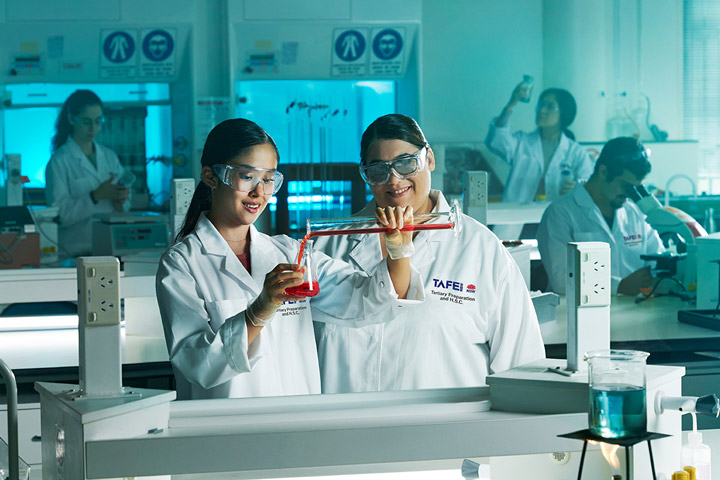
Through a mixture of theory and practical coursework, you will learn to work in a laboratory, prepare and analyse a range of chemical and biological samples, perform chemical and biological experiments, use a microscope to examine samples, perform manual, semi-automated and fully automated laboratory procedures, and understand work, health and safety procedures including infection control.
You need to successfully complete 16 units of competency, including 4 core units and 12 specialty units. Not all specialty units are offered at every TAFE NSW location, so it is recommended that you check with your preferred campus for available specialty units.
After completing the Certificate IV in Laboratory Techniques, you can progress to the Diploma of Laboratory Technology (Pathology), Diploma of Laboratory Technology (Food), or Diploma of Laboratory Technology (Chemistry). You can also pursue the Certificate III in Laboratory Skills, Certificate III in Pathology Assistance, or other related qualifications.
Yes, the Certificate IV in Laboratory Techniques can be completed as part of a traineeship. You should enquire directly with TAFE NSW to check the specific eligibility requirements for the traineeship pathway.
Application
Three simple steps to get enrolled
Step 01
Enquire
Click "Enquire Now" and tell us a little about yourself. It's free and takes 2 minutes.
Step 02
Submit Documents
Our team will guide you on exactly which documents to prepare and submit.
Step 03
Get Enrolled
Receive your offer letter and confirm your enrolment. Welcome to the course!
Honestly I was lost when I first started looking at Australian colleges. There are just too many options and every agent gives you different info. A friend told me about FindTheCourses and within a week I had shortlisted 3 programs that actually matched my budget and visa situation. My advisor Sanjay was super helpful — never felt like I was being pushed into anything.

Priya Sharma
India
Master of Nursing · Griffith University