

Start building today!
Experience the Find the courses and unlock the true potential
Course Overview
Where You Can Study
Brisbane
66 Ernest St, South Brisbane, QLD 4101
Student Information
Provider's Published Fee
Duration
Intakes
Study Mode
Eligibility
Domestic and International Students — English Language Requirement:
Domestic Students:
International Students:
Career & Study Pathways
Quality & Recognition
Academic Regulator
ASQA
Professional Body
Australian Nursing and Midwifery Accreditation Council (ANMAC)
Accreditation Status
AccreditedSkills Assessor
ANMAC
Course Content
Work with diverse people
This unit describes the skills and knowledge required to work respectfully with people from diverse social and cultural groups and situations, including Aboriginal and/or Torres Strait Islander people.
Promote Aboriginal and/or Torres Strait Islander cultural safety
The unit describes the skills and knowledge required to identify Aboriginal and/or Torres Strait Islander cultural safety issues in the workplace, model cultural safety in own work practice, and develop strategies to enhance cultural safety.
Reflect on and improve own professional practice
This unit describes the skills and knowledge required to evaluate and enhance own practice through a process of reflection and ongoing professional development.
Confirm physical health status
This unit describes the skills and knowledge required to obtain and interpret information about client health status and to check a client's physical health. It requires a detailed knowledge of anatomy and physiology.
Analyse and respond to client health information
This unit of competency describes the skills and knowledge required to analyse client health information and then to plan appropriate health services within scope of own role. It requires an in-depth knowledge of anatomy and physiology.
Practise nursing within the Australian health care system
This unit describes the performance outcomes, skills and knowledge required to practise as a nursing professional within the Australian health care system, providing health care across the lifespan of people in health and community care services and environments.
Apply communication skills in nursing practice
This unit describes the performance outcomes, skills and knowledge required to communicate effectively with people, families and carers, and with other health care professionals, in health care settings.
Perform clinical assessment and contribute to planning nursing care
This unit of competency describes the performance outcomes, skills and knowledge required, within the scope of practice, to perform preliminary and ongoing physical health assessments of all body systems, gathering data that contributes to an individualised health plan of care.
Implement, monitor and evaluate nursing care
This unit describes the performance outcomes, skills and knowledge required to implement nursing care as outlined in a person's nursing care plan, evaluate outcomes of care provided, record and report progress, and respond to emergency situations.
Apply principles of wound management
This unit describes the performance outcomes, skills and knowledge required to apply contemporary wound management principles to the care of persons with various types of wounds.
Administer and monitor medicines and intravenous therapy
This unit describes the performance outcomes, skills and knowledge required to administer and monitor medicine and intravenous (IV) therapy including calculating dosage requirements, reading and applying written instructions from an authorised prescriber, assessing the person for medicine effectiveness and side effects, and responding to an allergic pharmacological reaction.
Apply legal and ethical parameters to nursing practice
This unit describes the performance outcomes, skills and knowledge required to work within legal and ethical parameters in professional nursing practice, including supporting rights and meeting duty of care requirements.
Implement and monitor care for a person with mental health conditions
This unit describes the performance outcomes, skills and knowledge required to contribute to the nursing care and treatment of a person with a mental health condition.
Implement and monitor care for a person with acute health conditions
This unit describes the performance outcomes, skills and knowledge required to meet the assessed health care needs of people with acute health conditions.
Implement and monitor care for a person with chronic health conditions
This unit describes the performance outcomes, skills and knowledge required to meet the assessed health care needs of people with chronic health conditions.
Implement and monitor care of the older person
This unit describes the performance outcomes, skills and knowledge required to perform nursing interventions to support the social and emotional wellbeing and nursing care needs of the older person in care.
Apply nursing practice in the primary health care setting
This unit describes the performance outcomes, skills and knowledge required to work in a primary health care environment including community-based, educational, occupational and informal settings, and in general practice.
Provide end of life care and a palliative approach in nursing practice
This unit describes the performance outcomes, skills and knowledge required to provide a person-centred approach to palliative and end of life care in primary health care, hospitals, hospices, home and community care, and long-term care facilities.
Apply basic principles and practices of infection prevention and control
This unit describes the performance outcomes, skills and knowledge required to apply basic infection prevention and control principles in work settings including implementing standard and transmission-based precautions and responding to risks.
Follow safe work practices for direct client care
This unit describes the skills and knowledge required for a worker to participate in safe work practices to ensure their own health and safety, and that of others in work environments that involve caring directly for clients. It has a focus on maintaining safety of the worker, the people being supported and other community members.
Develop personal work priorities
This unit describes the skills and knowledge required to plan and prioritise own work tasks. It also addresses the skills and knowledge to monitor and obtain feedback on personal work performance.
Work effectively with others
This unit describes the skills and knowledge required to work cooperatively with others and deal effectively with issues, problems and conflict.
Research and apply evidence to practice
This unit describes the skills and knowledge required to establish the information need, gather information and critically analyse the information for relevance to own work.
Provide First Aid
This unit describes the skills and knowledge required to provide a first aid response to a casualty in line with first aid guidelines determined by the Australian Resuscitation Council (ARC) and other Australian national peak clinical bodies.
Contribute to the nursing care of a person with diabetes
This unit describes the performance outcomes, skills and knowledge required to provide nursing care to a person with diabetes including assessing needs, planning and implementing nursing interventions, evaluating outcomes, and educating the person on the condition and available resources.
Common Questions
Yes. By studying the Diploma of Nursing (HLT54121) through TAFE Queensland, graduates can be accepted into university nursing degrees at an advanced standing — for example, one graduate was accepted into the University of the Sunshine Coast and placed straight into second year, effectively saving a full year of study toward becoming a registered nurse.
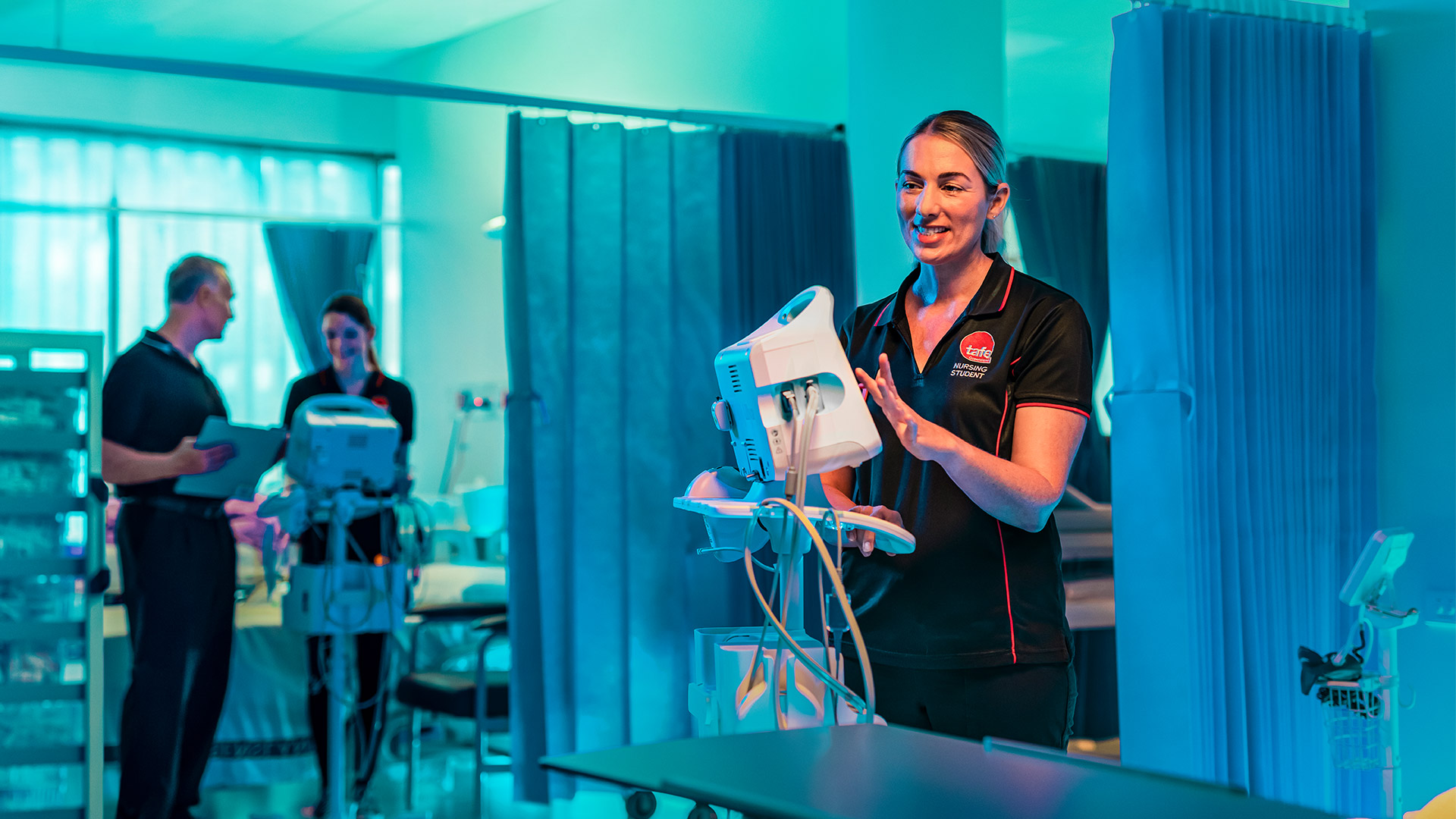
TAFE Queensland has simulation wards which are set up like a real hospital, to the point where they can actually be used as a hospital if needed. This hands-on environment means that everything students do in the simulation ward feels real when they transfer those skills across to placement.
Yes. Students who have been away from study for many years have successfully completed the Diploma of Nursing (HLT54121) at TAFE Queensland. The teaching staff are described as very supportive — encouraging students to be open and honest when they are struggling and providing the confidence needed to get through the course.
There are many different avenues available to graduates with nursing qualifications, including working in a hospital setting. The diploma also serves as a stepping stone toward becoming a registered nurse through a university degree pathway.
The Diploma of Nursing at TAFE Queensland has the course code HLT54121.
Application
Three simple steps to get enrolled
Step 01
Enquire
Click "Enquire Now" and tell us a little about yourself. It's free and takes 2 minutes.
Step 02
Submit Documents
Our team will guide you on exactly which documents to prepare and submit.
Step 03
Get Enrolled
Receive your offer letter and confirm your enrolment. Welcome to the course!
Processing time: Offer letter issued within approximately 1 business days.
Honestly I was lost when I first started looking at Australian colleges. There are just too many options and every agent gives you different info. A friend told me about FindTheCourses and within a week I had shortlisted 3 programs that actually matched my budget and visa situation. My advisor Sanjay was super helpful — never felt like I was being pushed into anything.

Priya Sharma
India
Master of Nursing · Griffith University

