
Start building today!
Experience the Find the courses and unlock the true potential
208 weeks
Full time / Part time
March 2027 (central scholarship round); applications accepted throughout the year for monthly intake periods

Course Overview
class="m-0 section-title__container anchorname" id="overview"> Overview Apply your advanced research skills to shape the future of digital healthcare. Digital health research plays an important role in enhancing our knowledge of the application and impact of digital technologies in healthcare and medicine. The School of Health and Biomedical Sciences conducts discovery, translational and clinical research focused on healthy ageing and chronic diseases. This is an interdisciplinary course, focused on building the capacity for digitally enabled healthcare. Our digital health research interests encompass electronic health records, mobile health applications, wearable devices, virtual care, health informatics, artificial intelligence (AI) in healthcare and data analytics.
Where You Can Study
Melbourne
124 La Trobe St, Melbourne, VIC 3000
Eligibility
class="m-0 section-title__container anchorname" id="admissions"> Entry requirements and admissions Expand all sections Collapse all sections Minimum requirements for admission Prerequisites Selection tasks Minimum requirements for admission The minimum requirements for admission to a PhD program are: A bachelor's degree requiring at least four (4) years of full-time study in a relevant discipline awarded with honours. The degree should include a research component comprised of a thesis, other research projects or research methodology subjects that constitute at least 25% of a full-time academic year (or part-time equivalent). The applicant must have achieved at least a distinction average in the final year. OR A master's degree that includes a research component comprised of at least 25% of a full-time academic year (or part-time equivalent) with an overall distinction average; OR A master's degree without a research component with at least a high distinction average; OR Evidence of appropriate academic qualifications and/or experience that satisfies the Associate Deputy Vice-Chancellor, Research Training and Development or nominee that the applicant has developed knowledge of the field of study or cognate field and the potential for research sufficient to undertake the proposed program. At RMIT a grade of distinction represents academic achievement of 70% or higher and a high distinction is 80% or higher. If you are a current master by research candidate, you are able to apply for a transfer to a doctor of philosophy program through the process prescribed in the RMIT Higher Degree by Research policy . Prerequisites There are no prerequisite subjects required for entry into this qualification. Selection tasks These entrance requirements are the minimum academic standard you must meet in order to be eligible to apply for the program. You will need to complete a selection task as part of your application. A selection process will be conducted in conjunction with the School and supervisors you nominate. For further information on the steps you need to take to apply for a research program see How to apply – Research programs . Expand all sections Collapse all sections Minimum requirements for admission Prerequisites Selection tasks English language requirements Minimum requirements for admission The minimum requirements for admission to a PhD program are: A bachelor's degree requiring at least four (4) years of full-time study in a relevant discipline awarded with honours. The degree should include a research component comprised of a thesis, other research projects or research methodology subjects that constitute at least 25% of a full-time academic year (or part-time equivalent). The applicant must have achieved at least a distinction average in the final year. OR A master's degree that includes a research component comprised of at least 25% of a full-time academic year (or part-time equivalent) with an overall distinction average; OR A master's degree without a research component with at least a high distinction average; OR Evidence of appropriate academic qualifications and/or experience that satisfies the Associate Deputy Vice-Chancellor, Research Training and Development or nominee that the applicant has developed knowledge of the field of study or cognate field and the potential for research sufficient to undertake the proposed program. At RMIT a grade of distinction represents academic achievement of 70% or higher and a high distinction is 80% or higher. If you are a current master by research candidate, you are able to apply for a transfer to a doctor of philosophy program through the process prescribed in the RMIT Higher Degree by Research policy . Prerequisites There are no prerequisite subjects required for entry into this qualification. Selection tasks Research proposal and supervisor Proposal You must attach a substantive research proposal that is 2 to 5 pages in length which articulates the intent, significance and originality of the proposed topic using the following headings: a) title / topic b) research questions to be investigated in the context of existing research/literature in the area c) significance and impact of the research d) methodology / research tasks required to undertake the research e) particular needs (e.g. resources, facilities, fieldwork or equipment that are necessary for your proposed research program, if applicable). Supervisor Your application will not be considered if you have not discussed your research topic with a proposed senior and associate supervisor or joint senior supervisors. You must provide the names of the academic staff in the school you have applied to and with whom you have discussed your proposed research. For further information on the steps you need to take to apply for a research program see How to apply – Research programs . English language requirements To study this course you will need to complete one of the following English proficiency tests: IELTS (Academic): minimum overall band of 6.5 (with no individual band below 6.0) TOEFL (Internet Based Test - IBT) for Australia: minimum overall score of 79 (with minimum of 13 in Reading, 12 in Listening, 18 in Speaking and 21 in Writing) Pearson Test of English (Academic) (PTE (A)): minimum score of 58 (with no communication band less than 50) Cambridge English: Advanced (CAE): minimum of 176 with no less than 169 in any component. Note: RMIT does not accept scores from 'at-home' or 'online' testing. For detailed information on English language requirements and other proficiency tests recognised by RMIT, visit English language requirements and equivalency information . Don't meet the English language test scores? Complete an English Language Pathways (Academic English) Advanced at RMIT University Pathways (RMIT UP). <div
Career & Study Pathways
class="m-0 section-title__container anchorname" id="career"> Career As a graduate, you will be highly sought after for a research or research-related career (including senior leadership and management positions) in various health and medical sectors, such as the biotechnology and pharmaceutical industry, government and public health, hospitals, universities and research institutes. Expected career pathways for graduates of this degree include: research and academic positions in universities, hospitals and research institutes pharmaceutical or biotechnology industry roles in research and development, data analysis, quality control, regulatory affairs, medical affairs or leadership and management government and public health careers, investigating public health issues, epidemiology, health policy and contributing to evidence-based decision-making. <div
Quality & Recognition
Academic Regulator
TEQSA
Accreditation Status
AccreditedCommon Questions
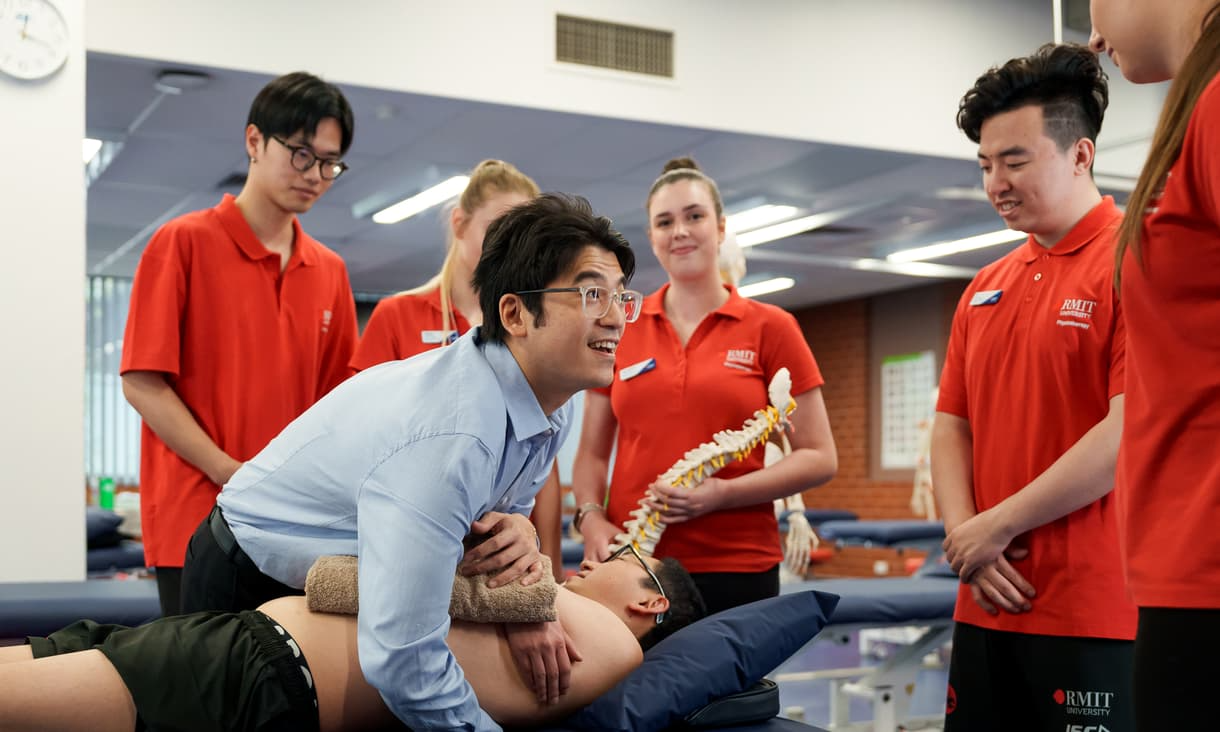
RMIT offers cutting-edge health facilities including a myotherapy clinic, nursing wards, the Digital Human Biosciences Facility, and the Bundoora Health Clinic. The RMIT Health Clinic is open to the public and offers a wide range of evidence-based and traditional health services, with 62 different treatment rooms where students are trained by industry practitioners in psychology, osteopathy, chiropractics, and Chinese medicine.
Yes, many of RMIT's health qualifications are accredited and/or nationally recognised by organisations such as the Dental Board of Australia and the Australian and Midwifery Accreditation Council (ANMAC).
RMIT offers courses across a wide range of health disciplines including allied health, dental studies, laboratory medicine, medical radiations, mental health, nursing, pharmaceutical sciences, pharmacy, physiotherapy, psychology, social work, and workplace health and safety, among others.
RMIT's undergraduate health degrees include first-year foundational subjects designed to help you learn the fundamentals of human anatomy and physiology, as well as develop your communication and professional skills. They also introduce you to factors that impact the health of individuals, particularly Australia's First Nations people.
Yes, RMIT has strong industry partnerships. For example, RMIT has been at the forefront of dental education for over 20 years and has extensive links with Dental Health Services Victoria, where students learn from experts in training facilities at the Royal Dental Hospital of Melbourne.
Application
Three simple steps to get enrolled
Step 01
Enquire
Click "Enquire Now" and tell us a little about yourself. It's free and takes 2 minutes.
Step 02
Submit Documents
Our team will guide you on exactly which documents to prepare and submit.
Step 03
Get Enrolled
Receive your offer letter and confirm your enrolment. Welcome to the course!
Processing time: Offer letter issued within approximately 1 business days.
Honestly I was lost when I first started looking at Australian colleges. There are just too many options and every agent gives you different info. A friend told me about FindTheCourses and within a week I had shortlisted 3 programs that actually matched my budget and visa situation. My advisor Sanjay was super helpful — never felt like I was being pushed into anything.
Priya Sharma
India
Master of Nursing · Griffith University
