Start building today!
Experience the Find the courses and unlock the true potential
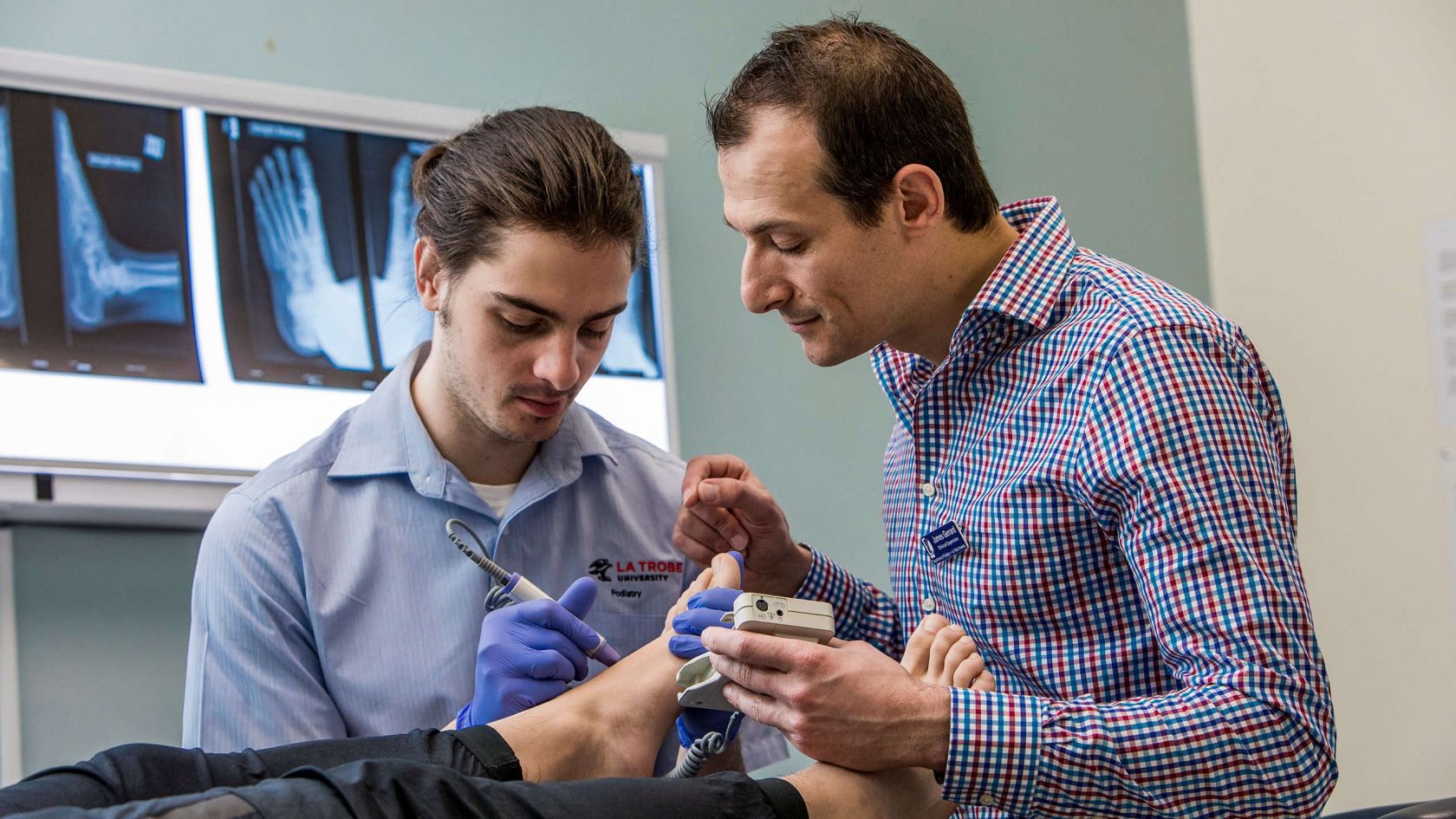
Course Overview
Take the first step towards helping others maintain and improve their mobility and independence with La Trobe's Bachelor of Podiatry (Honours).
In this degree, you'll benefit from being enrolled in the only podiatry program in Australia where graduates are qualified to prescribe scheduled medicines, enhancing your scope and impact in patient care. Learn from experienced podiatrists, world-leading researchers and teachers in sports medicine, biomechanics, hospital-based podiatry, private practice, paediatrics and foot surgery.
By completing La Trobe's Bachelor of Podiatry (Honours), you will:
Where You Can Study
Melbourne
Plenty Rd, Bundoora, Melbourne, Victoria 3086
Student Information
Provider's Published Fee
Duration
Intakes
Study Mode
Eligibility
Domestic students:
Recent secondary education (Year 12)
This course uses the ATAR as part of its selection considerations.
VCE: Units 3 and 4: a study score of at least 30 in English (EAL) or at least 25 in English other than EAL. Units 3 and 4: a study score of at least 25 in one of Biology, Chemistry, Health and Human Development, Physical Education , Physics, Psychology or any Mathematics.
Selection rank adjustments
VCE: A study score of 30 in any Mathematics, Physical Education, Health and Human Development or any Science equals 4 aggregate points per study. A study score of 20 in any LOTE equals 4 aggregate points per study. Overall maximum of 12 points.
Additional selection information
Applicants seeking consideration via Work Recognition must complete all requirements listed on the La Trobe University Work Recognition webpage and submit a Personal Statement, including relevant work experience and reasons for applying for this course.
Some prerequisites for this course can be satisfied by successfully completing specific subjects offered through Unilearn and achieving the minimum overall grade. Further details and minimum overall grade information is available from the La Trobe University Prerequisites page. Applicants who complete Unilearn studies must also submit a copy of their 'Statement of Achievement' and transcript to VTAC.
Subject Proficiency: Demonstrated proficiency equivalent to stated Year 12 prerequisites.
Applicants who have undertaken studies in a language other than English must demonstrate that they have achieved the required minimum scores in the International English Language Testing System (IELTS) (Academic) or equivalent. Refer to Language requirements for further information.
Applicants who have not successfully completed an Australian Year 12 or equivalent are ineligible to apply for this course. This course uses the ATAR as part of its selection considerations.
A study score of 30 in any Mathematics, Physical Education, Health and Human Development or any Science equals 4 aggregate points per study. A study score of 20 in any LOTE equals 4 aggregate points per study. Overall maximum of 12 points.
International students:
Recent secondary education (Year 12)
Units 3 and 4: a study score of at least 30 in English (EAL) or at least 25 in English other than EAL.
Units 3 and 4: a study score of at least 25 in one of Biology, Chemistry, Health and Human Development, Physical Education , Physics, Psychology or any Mathematics.
English language requirements
7.0 IELTS (Academic) with no individual band less than 7.0.
Please refer to our Language requirements page for details of other accepted English proficiency tests and additional recognised English language proficiency measures, such as English as the language of instruction.
All applicants:
Inherent requirements
Behavioural and relational skills
Core requirement Students must be able to manage their own responses and behaviour to work effectively in a range of learning environments with diverse people and tasks. This includes the capacity to be receptive and respond appropriately to constructive feedback. Students should also be able to work with others in a team or group environment and make and maintain effective relationships with a wide range of individuals in order to complete tasks or for professional practice. See also Student behaviours policy for more information. Course-specific requirement
Podiatry students require the capacity to manage their own emotions and behaviour effectively when working with peers, supervisors, patients and any other groups or individuals in practice settings.
Podiatry students are required to be examined by their peers and physically examine their peers and patients (of all genders, religions, and cultural backgrounds) in teaching and clinical / hospital environments.
Effective verbal and non-verbal communication is fundamental to podiatric practice and needs to be respectful, culturally safe, clear, attentive, empathetic, honest, and non-judgemental.
The ability to observe and understand culturally safe non-verbal cues assists with building rapport with people and gaining their trust and respect in academic and professional relationships. For example, displaying consistent and appropriate facial expressions, culturally safe eye contact, being mindful of space, time boundaries and body movements and gestures promotes trust in academic and professional relationships. Additionally, being sensitive to individual differences displays respect and empathy to others and develops trusting relationships.
The ability to observe and understand verbal and non-verbal cues is essential for safe and effective observation, recording and reporting of client symptoms and reactions to facilitate assessment, intervention, and treatment.
The ability to work collaboratively in teams, advocate for patients and their supports, and implement leadership skills is important for being able to provide safe and effective patient care.
Cognition
Students must be able to locate, acquire, retain and apply knowledge as part of their learning and for assessment. They must have the ability to sustain their attention over a designated period, maintain their focus in a variety of learning environments and remember information long enough to complete tasks in a reasonable and safe timeframe.
Safe and effective delivery of podiatry services is based on comprehensive knowledge that must be sourced, understood, and applied appropriately. This includes conceptualising and using appropriate knowledge in response to academic assessment items. It also includes appropriately applying knowledge of theory, research evidence, policies, and procedures in a range of learning and clinical environments. Literacy skills are required to: convey spoken and written messages accurately and effectively; paraphrase, summarise and reference in accordance with appropriate academic conventions in written assignments. Additionally, effective written communication is required to ensure clinical documentation meets professional and legal requirements. Competent application of numeracy skills is essential in podiatry to facilitate the safe and effective service delivery. Examples include recording accurate measurements in client notes; Prescribing footwear and orthotics devices (including componentry) that correctly meets client measurement, weight, and activity requirements; Writing prescriptions for pharmaceuticals and medicines where accurate communication of both numeric and written language is vital for patient safety.
Podiatry service delivery requires sufficient physical and mental endurance to perform multiple tasks in an assigned period and the ability to perform repetitive activities with a level of concentration that ensures a capacity to focus on the activity until it is completed appropriately. Examples include participating in tutorials and lectures in a range of learning environments; Providing consistent, timely podiatry service delivery over a negotiated time frame while on placement.
Refer to The Podiatry Board Professional Capabilities for PodiatristsPodiatry Board of Australia - Accreditation publications and resources
Sensory (visual, auditory, tactile, olfaction)
Students should possess the ability to interact with visual, auditory or tactile inputs sufficiently to manage their learning environment and to meet professional performance needs.
Podiatry students require sufficient visual acuity to demonstrate the required range of skills, tasks, and assessments to maintain consistent, accurate and safe care to self and others. Visual observations, examinations and assessment are fundamental to safe and effective podiatric service delivery. Examples include observing and detecting subtle changes in posture, gait, general movement, integrity of the skin and physical systems (e.g., vascular and neurological status) and the ability to perform functional activities during assessment and treatment. Safely operating equipment, tools, and machinery e.g. equipment - grinders, dopplers and sterile operating spaces and the ability to visualise and interpret images (e.g., x-rays and MRI scans).
Sufficient auditory ability is necessary to monitor, assess and manage individual health needs consistently and accurately. Auditory assessments and observations are fundamental to safe and effective podiatry service delivery. Examples include ability to detect and respond to auditory warning / alarm systems; Detecting care requests by calls for help or activation of a call bell (hospital environment); Engaging appropriately to a patient's responses during an assessment.
Tactile assessments and observations are fundamental to safe and effective service delivery, sufficient tactile ability is necessary to monitor, assess and detect patients' physical characteristics and act on any abnormalities detected. Podiatry examples include: Detecting changes in circulation, e.g. temperature; Palpating joints, muscles, and soft tissues, and detecting anatomical or movement abnormalities; Ensuring orthotic devices and shoes fit correctly and are technically safe for patient use.
Strength and mobility
Gross motor skills: Students should possess the strength, range of motion, coordination and mobility sufficient to manage their learning environment and ultimately, professional performance needs. Fine motor skills: Students should possess the manual dexterity and fine motor skills sufficient to manage their learning environment and ultimately, professional performance needs.
Podiatry students require sufficient gross and fine motor skills to provide, coordinate and prioritise service delivery. This includes the ability to appropriately position self, equipment, and clients to perform tasks consistently and safely to reduce risk of harm to self and others. Tasks that involve gross motor skills include lifting, carrying, pushing, pulling, standing, twisting, and bending. Tasks that involved fine motor skills include being able to grasp, press, push, turn, squeeze and manipulate various objects and individuals. Examples of gross motor skills that are important for podiatry include: Maintaining own and client's balance during assessment and treatment; Completing technical task such as modification of orthotic devices, using specialised equipment to undertake assessment and performing routine nail and skin management; Evaluating clients in a safe and effective manner, who have varying physical capacity, who are positioned on plinths and hospital beds, on chairs and when standing. Examples of fine motor skills that are required for podiatry include: Performing assessment techniques, e.g. evaluation of sensation and joint movement; Performing technical tasks, e.g. fabrication of padding and strapping, including the use of hand tools such as electric nail drills, grinders and dopplers. Diagnostic and therapeutic instrumentation including use of sterile equipment for injection.
Career & Study Pathways
The broad clinical experiences you'll gain at La Trobe will ensure you're job-ready after graduation, entering a workforce with high employment rates and a strong demand for podiatrists. Potential fields include:
Quality & Recognition
Academic Regulator
TEQSA
Professional Body
Australian and New Zealand Podiatry Accreditation Council (ANZPAC)
Accreditation Status
AccreditedSkills Assessor
ANZPAC
Course Content
Academic Integrity Module
Wominjeka La Trobe: Indigenous Cultural Literacy for Higher Education
Cutaneous Science of the Foot
Foundations of Professional Communication
Human Biosciences A
Introduction to Human Anatomy
Microbiology for Allied Health
Podiatric Practice A
Research and Evidence in Practice
Understanding Health and Wellbeing
Anatomy: Lower Limb & Foot
Integrating Evidence into Practice
Pathophysiology
Pharmacology for Health Professionals
Podiatric Pathophysiology and Assessment
Podiatric Populations A
Podiatric Practice B
Podiatric Practice C
Musculoskeletal Pathology for Podiatrists
Podiatric Biomechanics
Podiatric Pharmacology
Podiatric Populations B
Podiatric Practice D
Podiatric Practice E
The High-Risk Foot
Medical Conditions Affecting the Foot
Podiatric Practice F
Podiatrist Practice G
Common Questions
The Bachelor of Podiatry (Honours) is an undergraduate degree offered at La Trobe University, however the page content provided does not include a detailed course description or overview beyond the course title.
You can find more information about the Bachelor of Podiatry (Honours) by visiting La Trobe University's official course pages, contacting the university directly via their contacts page, or using the course search feature on the La Trobe website.
Yes, La Trobe University is a registered Australian University with TEQSA provider registration number PRV12132 and CRICOS Provider number 00115M, making it a recognised institution for both domestic and international students.
Application
Three simple steps to get enrolled
Step 01
Enquire
Click "Enquire Now" and tell us a little about yourself. It's free and takes 2 minutes.
Step 02
Submit Documents
Our team will guide you on exactly which documents to prepare and submit.
Step 03
Get Enrolled
Receive your offer letter and confirm your enrolment. Welcome to the course!
Processing time: Offer letter issued within approximately 1 business days.
Honestly I was lost when I first started looking at Australian colleges. There are just too many options and every agent gives you different info. A friend told me about FindTheCourses and within a week I had shortlisted 3 programs that actually matched my budget and visa situation. My advisor Sanjay was super helpful — never felt like I was being pushed into anything.

Priya Sharma
India
Master of Nursing · Griffith University